Geometry as the Ground Truth
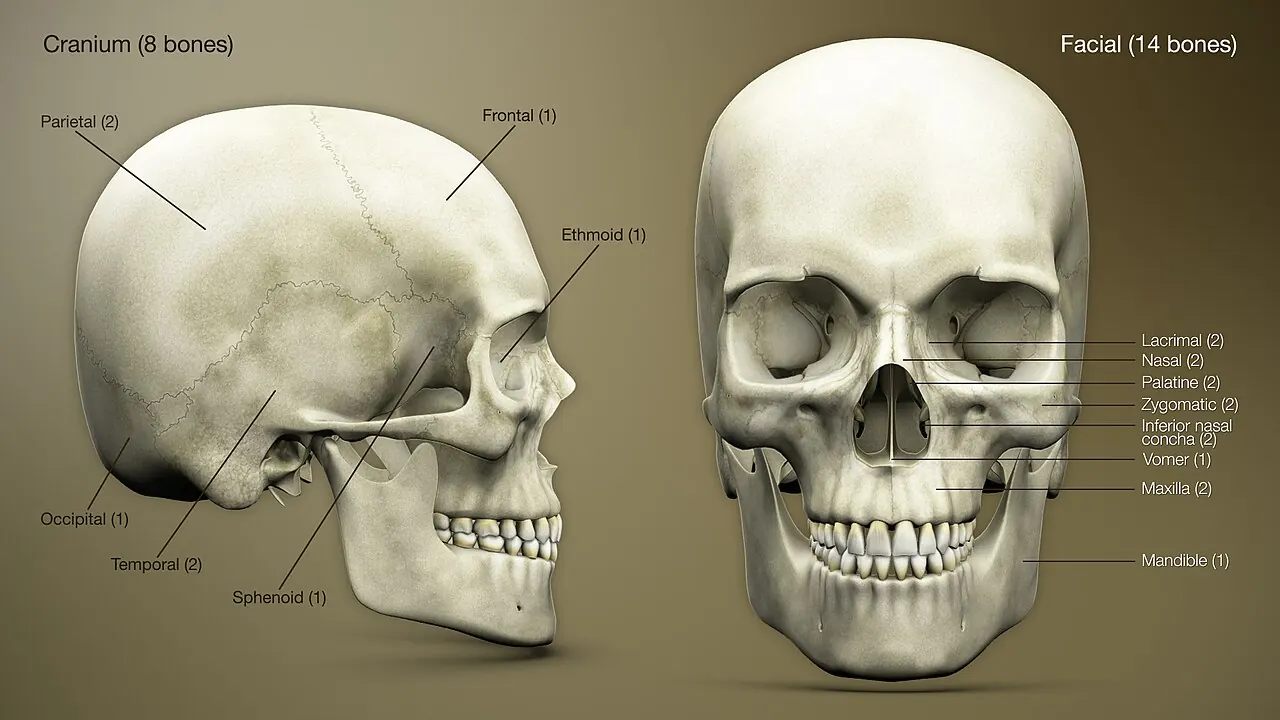
Facial geometry is remarkably stable across time and conditions. Your skull structure, cheekbone prominence, eye socket depth, and inter-landmark distances do not change with lighting, expression, or the passage of decades the way skin texture and surface appearance do. This stability is the foundation on which accurate face recognition is built, the stable geometric signal beneath the variable surface is large enough to identify individuals reliably.
When a deep neural network processes a face, it does not receive explicit geometric measurements. Instead, through training on millions of face pairs with known identities, it gradually builds internal representations that encode the patterns of geometry that predict identity. The network never receives instruction to measure cheekbone width, it discovers that such patterns matter, and learns to encode them efficiently.
What Convolutional Layers Actually Learn
The early layers of a face recognition network respond to simple image gradients, boundaries where dark meets light. Middle layers combine these into edges, curves, and local shapes. By the final convolutional layers, the network has built representations that capture facial structure at a geometric level: the arc of the brow ridge, the depth of the nasolabial fold, the angle of the jaw.
These representations implicitly encode proportional relationships: the ratio of inter-ocular distance to face width, the length of the midface from nose tip to eye level, the prominence of the mandible relative to the rest of the face. The network did not learn to measure these explicitly, they emerge from the optimisation of a training objective that requires same-identity face pairs to produce nearby embeddings.
Landmarks: Lining the Face Up First
Before the network sees a face, a detector finds five facial landmarks: the centres of both eyes, the tip of the nose and the two corners of the mouth. Ollie uses InsightFace for this. The landmarks are used to rotate and scale the face into a standard 112 × 112 crop, so every face is compared in the same position.
Some systems also feed hand-measured ratios, like eye spacing or nose width, into the match. Ollie doesn't: its match score comes from the neural network's fingerprint alone, because a network trained on millions of faces learns more reliable cues than a few hand-picked measurements.
Why Math Outperforms Human Intuition
Human observers are surprisingly unreliable at unfamiliar face comparison. In controlled studies where trained forensic examiners compare photos of unknown individuals, accuracy peaks at around 80–85% on difficult pairs. Under the operational conditions of real identification tasks, stress, time pressure, poor image quality, performance degrades further.
A well-trained AI system operating on face embeddings consistently exceeds human performance on standard benchmarks. On LFW (Labeled Faces in the Wild), the industry-standard benchmark of realistic face pairs, modern models achieve above 99% accuracy, far beyond the human ceiling. The advantage is not intelligence but consistency: the same mathematical operation applied identically to every image, without fatigue or attentional variation.