What Is Prosopagnosia?
Prosopagnosia, often called face blindness, is a neurological condition characterised by inability to recognise faces, including, in severe cases, the person's own face in a mirror. People with prosopagnosia typically have normal vision and can describe individual facial features clearly, but cannot use that information to identify who a face belongs to. They compensate by relying on other cues: voice, gait, hairstyle, clothing, and context.
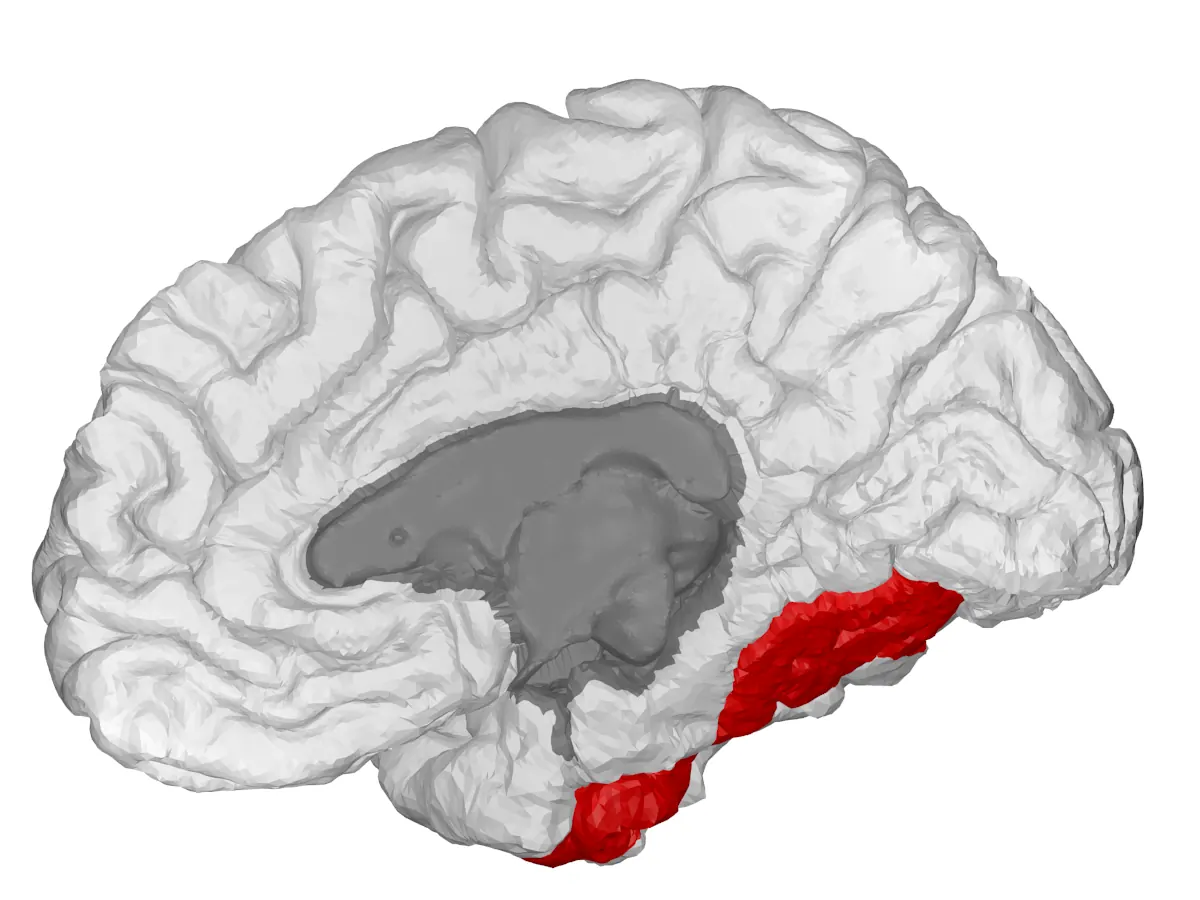
The condition exists on a spectrum. Acquired prosopagnosia results from brain damage, typically to the right fusiform gyrus or nearby occipitotemporal regions, following stroke or traumatic brain injury. Developmental prosopagnosia arises without brain damage, as a failure of the face processing system to develop normally. Recent research suggests developmental prosopagnosia is more common than previously thought, affecting perhaps 2–2.5% of the population to some degree.
The Fusiform Face Area
The primary neural substrate for face recognition is the fusiform face area (FFA), a region of the fusiform gyrus in the inferior temporal cortex that shows selective activation for face stimuli. In prosopagnosia, FFA activation during face viewing is typically reduced or abnormal. Damage to the FFA, or disrupted connectivity between the FFA and downstream memory regions, produces the characteristic inability to recognise familiar faces.
The FFA's functional specialisation for faces has been debated, some researchers argue it responds to any object category for which the observer has developed expert-level discrimination, not just faces. But the clinical evidence from prosopagnosia is clear: damage to this specific region selectively impairs face recognition while leaving object recognition largely intact. The specialisation is real, whatever its ultimate computational basis.
What Prosopagnosia Teaches Us About AI
Prosopagnosia provides a natural experiment in selective face recognition failure. The condition reveals that face recognition is computationally distinct from object recognition, it is not simply difficult object recognition but a separate capability with its own dedicated neural hardware. When that hardware is damaged or absent, identity cannot be extracted from appearance even when all the visual details are perceived correctly.
AI face recognition systems are analogously modular: the face embedding network is a specialised component trained exclusively for the face recognition task. Its selectivity and power come from this specialisation, just as the FFA's power comes from its selective tuning. The parallel suggests that building highly capable face recognition requires dedicated, specialised systems rather than general-purpose visual intelligence.