Turning Faces into Coordinates
An embedding is a technique for representing complex objects as points in a mathematical space. In face recognition, a facial embedding transforms a face photograph into a vector, a list of numbers, that represents the face as a coordinate in high-dimensional space. The defining property of a well-trained embedding is that it preserves meaningful relationships: faces of the same person cluster together, faces of different people are spaced apart.
This transformation is what makes celebrity face matching computationally feasible. You cannot efficiently search thousands of celebrity photos by direct image comparison. But you can search thousands of pre-computed embedding vectors in milliseconds, finding the closest ones to any query vector you provide.
The 512-Dimensional Space
Ollie uses a 512-dimensional embedding space. Each number in the vector captures a different aspect of the face's identity-relevant geometry, none of them correspond directly to a single measurable feature, but together they encode identity with high precision. Every celebrity in the database has been processed by the neural network and their 512-number embedding stored. When you upload a photo, your face is processed the same way, producing another 512-number vector in the same space.
The vectors are L2-normalised, placing them all on the surface of a 512-dimensional unit sphere. Comparing any two normalised vectors reduces to computing cosine similarity, the angle between two points on the sphere's surface. This makes comparison both mathematically clean and extremely fast, which is essential for searching a database of thousands of celebrities in real time.
Searching Thousands of Faces in Milliseconds
Because every celebrity fingerprint is computed ahead of time, a search only has to compare one new fingerprint with the stored ones. For a database of tens of thousands of photos, Ollie simply compares your fingerprint with every one of them: a single matrix calculation that takes a few milliseconds and never misses a closer match.
Much larger systems, with millions or billions of faces, use approximate nearest-neighbour libraries such as FAISS (Facebook AI Similarity Search), which skip most comparisons in exchange for a small chance of missing the true nearest match. The same pattern, a neural network producing embeddings plus a fast search over them, powers image retrieval, music recommendation and semantic text search.
What Embedding Space Reveals About Faces
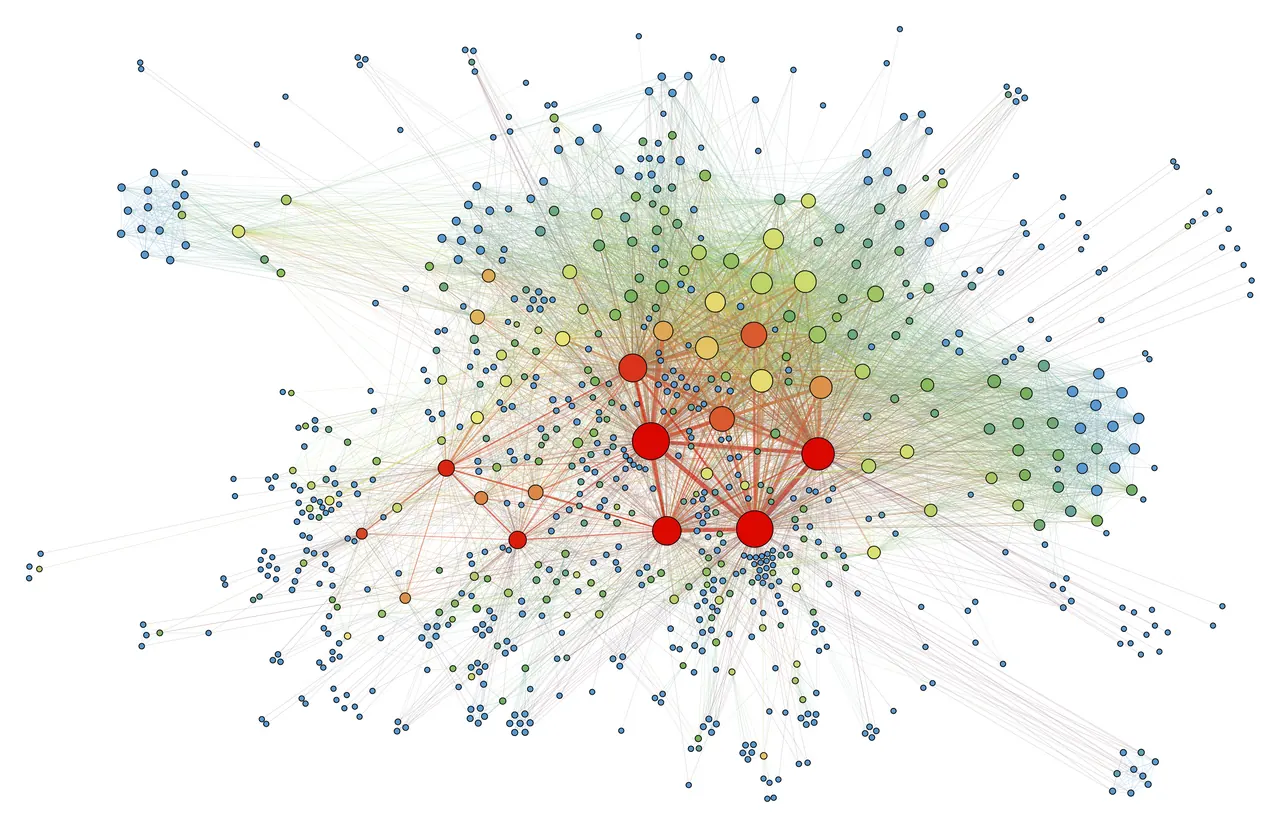
When all celebrity embeddings are visualised using dimensionality reduction techniques, they form a structured distribution, not a random cloud of points. Faces cluster by age group, ethnicity, and what might be called facial archetype, groups of people who share geometric proportions without necessarily sharing demographic characteristics. Your embedding lands somewhere in this distribution, and the celebrities nearest to you are your matches.
The position of your embedding also explains aspects of your results that might otherwise seem surprising. If your top matches are all from a particular era or demographic, it usually means your facial proportions cluster near those celebrities in the embedding space, a reflection of shared geometry, not shared background.